
CNC Lathe Services
Resolute Precision Manufacturing operates a complete CNC lathe department, including 2-axis bar-fed lathes, Y-axis dual-spindle lathes, and 9-axis mill/turn centers. Our CNC lathe services produce custom CNC lathe parts from 3/8-inch bar stock up to 25.5-inch chucked workpieces. With advanced machining capabilities across our equipment, we can complete complex parts efficiently in a single setup. Request a QuoteCNC Lathe Machining for Complex Parts
Our CNC lathe machining capabilities cover a wide range of production requirements, from simple cylindrical components to complex multi-feature parts. We match each job to the appropriate machine configuration based on the part design, material, production volume, and required features.
A simple cylindrical fastener may run most efficiently on a 2-axis bar-fed lathe, while a part requiring front- and back-side milling may benefit from a Y-axis dual-spindle machine. Highly complex components combining turning, milling, drilling, tapping, and compound angles can be produced on our 9-axis mill/turn centers.
This range of equipment allows our team to select the right process rather than forcing every job onto the same machine type. The result is efficient CNC lathe machining services designed around your specific part requirements.
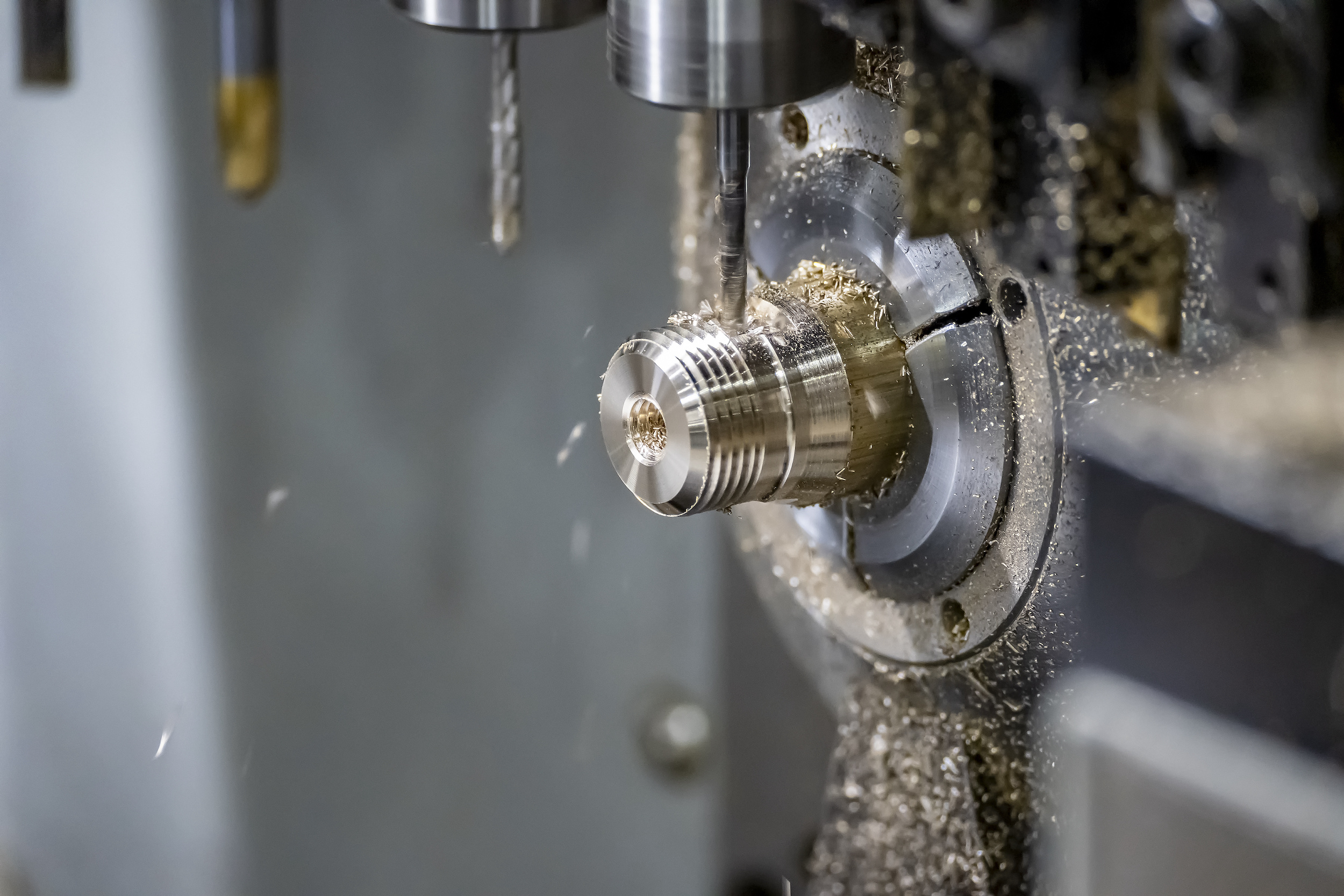
What Is CNC Lathe Machining?
It is a process in which the workpiece rotates while computer-controlled cutting tools remove material to create the required diameter, profile, and features. Because the motion is programmed, the process is accurate, repeatable, and well suited to production runs where every part must match the last.
Our lathe turning services are used for shafts, bushings, fittings, flanges, inserts, nuts, bolts, and many other round components. Whether you need a prototype or a medium to high volume production run, a modern turning lathe gives you consistent results with efficient cycle times.
Choosing the Right Lathe Configuration
Use this guide to select the right configuration for your part:
- 2-Axis bar-fed lathe: Round symmetrical parts, high-volume fasteners, shafts, bushings, and spacers with no milled features.
- Y-Axis dual spindle: Parts requiring off-center milling plus complete front and back machining in one cycle.
- 9-Axis mill/turn: The most complex parts combining turning, milling, drilling, and tapping with compound angles and dual-spindle operations.
- Swiss-type (see below): Small, slender, tight-tolerance parts.
Learn more on our dedicated pages: 2-Axis CNC Lathe Services, Y-Axis CNC Lathe Services, and Multi-Axis CNC Turning.
CNC Lathe Live Tooling for Single-Setup Parts
Live tooling puts powered, rotating cutting tools on the lathe turret, so the machine can mill, drill, and tap while the part is still held in the spindle. With CNC lathe live tooling, features such as cross holes, flats, slots, and threaded openings are machined in the same setup as the turned diameters.Doing it all in one setup means fewer handling steps, better feature-to-feature accuracy, shorter lead times, and lower cost per part. It is a key reason our Y-axis and 9-axis machines can finish complex components that would otherwise need secondary operations.
CNC Lathe Turning Tools and Process Control
The right cutting tool matters as much as the machine. Our team selects CNC lathe turning tools, including inserts, boring bars, grooving and threading tools, and drills, to suit your material, tolerance, and surface finish requirements. Tool choice, speeds, feeds, and coolant are tuned for each job to protect part quality and tool life.
To keep production consistent, we combine this tooling expertise with in-process and final inspection, so the last part in a run matches the first.
CNC Swiss Lathe Machining
For small, slender, or highly precise components, we also offer CNC Swiss lathe machining. A Swiss-type machine supports the material close to the cutting tool, which reduces deflection and holds tight tolerances along the length of long, thin parts. It is a strong fit for medical, electronics, and fluid power components. See our CNC Swiss Machining page for details.
Industries Served and Custom CNC Lathe Parts
We supply turned components to customers in aerospace, medical devices, automotive, industrial parts, fluid power, and robotics. Typical CNC lathe parts include bolts, bushings, fittings, flanges, inserts, nuts, and shafts, from first prototypes through ongoing production.
Beyond machining, our value-added services cover heat treating, grinding, coatings, assembly, and inventory management, so your lathe services and finishing can come from a single supplier.
Why Choose Us for CNC Lathe Services
- Right machine for the job: a full range of turning lathe configurations, so each part runs on the most efficient one.
- Complete parts in one setup:live tooling and dual spindles reduce handling and secondary operations.
- Medium to high volume focus:our lathe turning services are built for medium to high volume production, with an emphasis on quality and on-time delivery.
- Prototype to production:the same team supports both.
- Fast response:send a drawing for a free manufacturing feasibility review. We respond within 24 hours.
Frequently Asked Questions
What is the largest part RPM can turn on a CNC lathe?
Our turning centers handle chucked workpieces up to 25.5″ in diameter and 44″ in length. For bar-fed production, we accept bar stock up to 3.2″ diameter.
What is the advantage of Y-axis turning over a standard lathe?
A standard 2-axis lathe turns on the center line only. A Y-axis lathe adds off-center movement, so it can mill flats, slots, and holes away from the center line without moving the part to another machine. Combined with a dual spindle, it also completes the back side of the part in the same cycle, which improves accuracy and cuts lead time.
Can RPM machine both ends of a part in a single setup?
Yes. Our Y-axis dual-spindle lathes and 9-axis mill/turn centers pass the part from the main spindle to the sub-spindle, so both ends are machined in one cycle. This reduces handling and keeps both ends accurately aligned to each other.
What deep-hole drilling capability does RPM offer?
We drill holes up to 5 to 8 times the hole diameter on our turning centers. For example, a 1/4″ diameter hole can be drilled up to 2″ deep in a single pass without peck drilling.
Do you offer CNC Swiss machining as well as standard lathe services?
Yes. For small-diameter, long, and tight-tolerance parts, we offer CNC Swiss machining alongside our standard CNC lathes, so we can choose the best process for each part.
What materials can you machine on your CNC lathes?
We machine aluminum, stainless steel, alloy steel, brass, copper, bronze, titanium, and carbon steel, as well as plastics including ABS, acrylic, Delrin, HDPE, nylon, and PVC.
Do you handle both prototypes and production runs?
Yes. We support prototype quantities and medium to high volume production.