
Multi-Axis CNC Turning
Resolute Precision Manufacturing provides CNC multi-axis machining for complex precision components that combine turning, milling, drilling, threading, and other features in a single machining process. Our 9-axis mill/turn centers combine CNC turning with multi-axis milling capabilities, allowing complex parts to be completed with fewer setups and less part handling.By combining multiple operations on one machine, our multi-axis CNC capabilities help maintain dimensional relationships between turned and milled features while reducing setup time and secondary operations. Parts that would traditionally require multiple machines and setups can often be completed in a single machining cycle. Request a QuoteAdvanced Multi-Axis CNC Turning Capabilities
Multi-axis CNC turning uses advanced CNC turning centers with multiple controlled axes to perform turning and milling operations on complex components. Our most capable mill/turn centers provide up to nine controlled CNC axes, incorporating X, Z, Y, C-axis spindle positioning, B-axis tool movement, main and sub-spindle operations, and auxiliary axes.
The result is a highly capable multi-axis CNC lathe that can perform multiple machining operations without repeatedly transferring the part between machines.
A single mill/turn cycle can include turning the outside diameter, boring the inside diameter, cross-drilling holes, milling flats, cutting threads, machining end faces, and completing features from multiple orientations. Depending on part geometry and production requirements, this approach can significantly reduce setup requirements while maintaining consistent feature relationships.
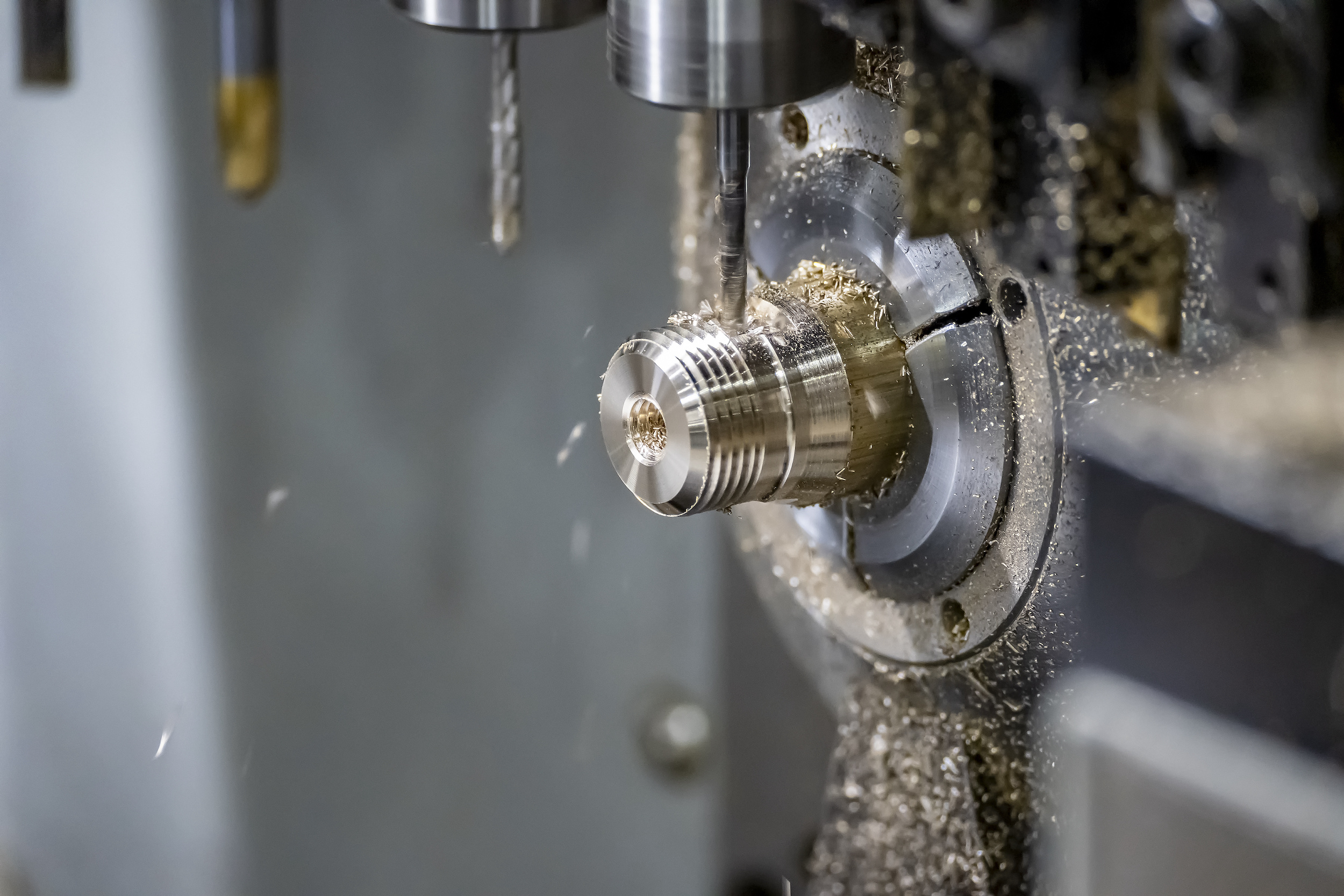
Precision Multi-Axis Machining for Production Runs
Precision multi-axis machining is not only for one-off prototypes. Because a single machine finishes the part, proven programs and stable workholding can be repeated across ongoing orders, which keeps quality consistent and helps control unit cost. We run multi-axis CNC turning for prototype quantities and for medium to high volume production.
Benefits of Multi-Axis CNC Turning
- Fewer secondary operations: turned, milled, drilled, and tapped features are often completed in one process.
- Better feature alignment: fewer part transfers help maintain the relationship between turned and milled details.
- Efficient production flow: a shorter route through the shop for complex parts and repeat orders.
- Strong repeatability: controlled programs and consistent work holding give consistent results from part to part.
- Cost control on repeat runs: fewer setups and less handling improve efficiency on higher-volume orders.
- Versatility: a strong fit for shafts, fittings, connectors, housings, and other precision components.
Why Single-Setup Machining Matters for Quality
Every time a part is removed and repositioned, there is an opportunity for variation in how the part is referenced and aligned. Reducing the number of setups can help maintain the positional relationship between features and minimize variation caused by additional fixturing and part handling.
With CNC multi-axis machining, multiple features can be produced while the part remains referenced within the same machining process. Turned, milled, drilled, and threaded features can therefore be machined from a consistent datum structure rather than relying on repeated manual re-fixturing.
For complex components with tight positional requirements between turned and milled features, fewer setups can simplify the manufacturing process and support more consistent results.
3 Axis, 4 Axis, and Multi-Axis: What's the Difference?
The number of axes describes how many directions the machine can move the tool and the part, and it decides how many features can be finished in one setup.
3 axis CNC machining moves the tool along X, Y, and Z. It works well for simple prismatic parts and features on a single face.
4 axis CNC machining adds rotation of the part, so features can be machined around a cylinder or on several sides without manual repositioning.
Multi-axis CNC turning goes further. A mill/turn center combines turning with Y-axis and B-axis milling, C-axis positioning, and main and sub-spindle operations, so complex round parts are completed in one cycle.
Choosing the right level is a cost decision as well as a technical one. We review your drawing and recommend the simplest process that meets your tolerances. If your part only needs 3 axis CNC machining or 4 axis CNC machining, we will not push it onto a more complex machine. See our CNC milling services for more.
Industries We Serve
We provide multi-axis CNC turning for manufacturers in aerospace and defense, medical devices, automotive, industrial parts, fluid power, and robotics. Our parts are machined from metals such as aluminum, stainless steel, alloy steel, brass, copper, bronze, titanium, and carbon steel, as well as plastics including ABS, acrylic, Delrin, HDPE, nylon, and PVC.
Frequently Asked Questions
How many axes does RPM's most capable turning center have?
Our most capable mill/turn centers operate up to 9 simultaneously controlled CNC axes including X, Z, Y, C-axis spindle positioning, B-axis tool tilting, and independent main and sub-spindle drives.
What is the difference between multi-axis turning and 5-axis milling?
Multi-axis turning starts with rotating bar stock and uses turning as the primary material removal process, adding milling within the same cycle. Five-axis milling starts from stationary billet material using milling as the primary process. Parts that are primarily round in their final form are nearly always more efficiently produced on a mill/turn center.
Can a 9-axis mill/turn center replace four separate machines?
Yes this is exactly what it is designed to do. Parts previously requiring a lathe, milling machine, drill press, and secondary lathe can be completed on a single 9-axis machine in a fraction of the total time.
Does RPM quote complex mill/turn parts?
Yes. We specialize in complex mill/turn components that other shops decline or struggle to quote accurately. Send us your drawing for an honest assessment of the best machining strategy.